Cairde an Chláir, a federation of local Clare river angling clubs Tuam, Cregmore/Athenry and Milltown are delighted to announce another successful year for the collaborative working arrangement with Inland Fisheries Ireland (IFI). The state agency for the protection and conservation of fish in Ireland have now completed two 600m headwater nursery stream developments within the Clare river catchment for the recruitment of wild brown trout and salmon, one at Killaclogher, Abbert river and a second on the Grange river at Mahanagh.

These two sites are now fully protected with 2000m of fencing installed to prevent farm stock from wading into streams or grazing stream margins. This alleviates farm stock damage to the enhanced developments; overgrazing of stream margins which impacts on regeneration of trees and marginal plants, poaching of river banks which causes excess bank spoil to be pushed into the waterway, and avoids issues where water quality is concerned. If we add this years 1200m of Clare river headwater stream enhancements to previous enhancements over the last five years and calculate an average channel width of 3m, a total in excess of 20,000 square metres of headwater Clare river catchment streams have now been enhanced for the recruitment and survival success of young wild brown trout and salmon.
IFI are committed to this vital work, work which involves restoring habitat that is now unproductive for wild fish to breed because it has been damaged or destroyed by land drainage schemes and farming practices. Once a stream site has been identified that is performing poorly, the damaged habitat is rectified to improve the recruitment success of wild fish. By introducing gravel for spawning and creating habitat that will support juvenile fish, these introductions provide the natural conditions for the breeding success of our wild fish populations, and damaged streams which have been unproductive and lost to the system are rejuvenated and brought back into play again. These enhancements are sympathetically performed, every effort is made to avoid causing any local disturbance to wildlife or the environment and once completed, they should only require periodic maintenance to ensure that they continue to deliver. So for a one off cost to deliver the scheme, they offer great value for money.
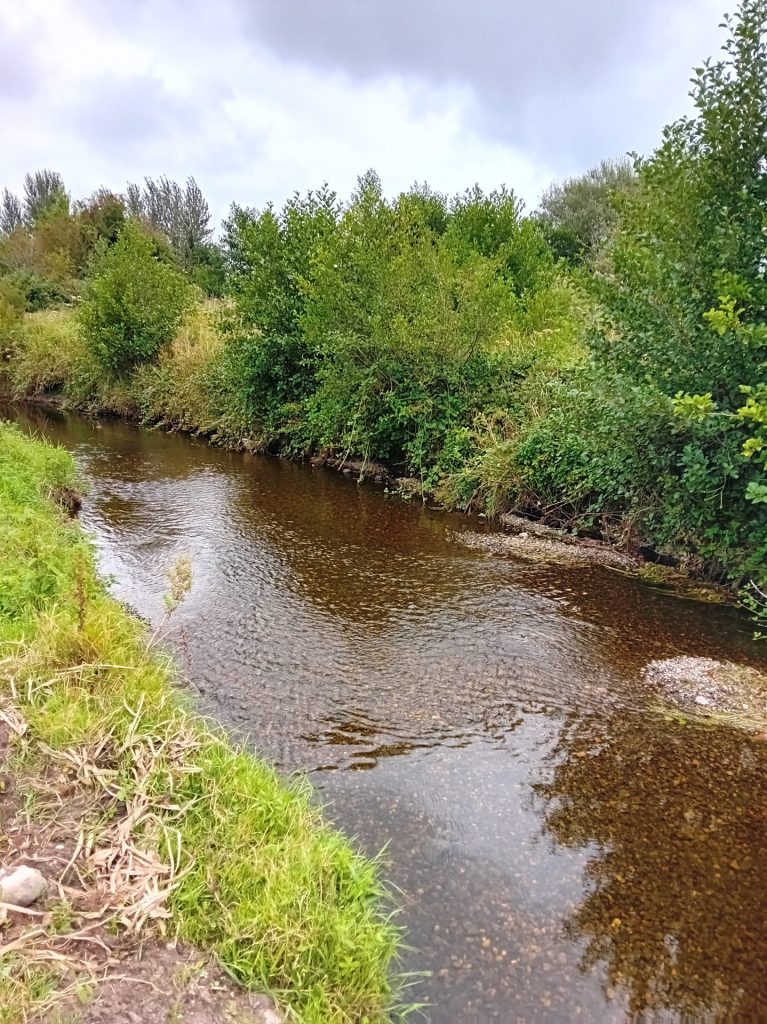
The Clare river is part of the greater Corrib catchment. 28% of adult brown trout caught in Lough Corrib are produced by the Clare river catchment. If we consider that a square metre of productive stream habitat will support a wild Juvenile brown trout, then the 20,000 square metres of enhanced stream habitat completed by IFI now has the potential for producing 20,000 juvenile wild fish per year. This is a natural process which will be repeated every year. That is the big advantage of stream enhancements, the work once finished continues to be productive annually and if we were to move it forward 10 years, then this vital work could potentially produce 200,000 wild fish to the Corrib system over a 10 year period.
1 square metre of good habitat = 1 wild juvenile fish
If we use this formula to calculate potential success, then for every square metre of damaged habitat enhanced, we increase the overall success of a development by the figure of total square metres enhanced, e.g. 20,000 square metres of enhanced site = 20,000 wild juvenile fish.
Cairde an Chláir do not encourage hatchery support for increasing fish stocks as it is a strategy which once started, has to be repeated every year, an action which makes it very costly. It is also unsustainable, and inflicts negative impacts on wild fish and the environment. This is why we prefer stream enhancements of damaged nursery habitat to improve the recruitment of wild fish. They are the most cost effective strategy and support a natural reproductive process. Provide the right conditions for fish recruitment and survival, and nature will do the rest. Fish are very fecund, a 1kg mature female brown trout can produce 2000 eggs, so the more habitat that we can restore, the greater the potential for breeding success. Every square metre enhanced, increases the potential for another wild fish. Improving the conditions for wild fish recruitment and supporting it with conservation measures to protect mature fish, is an internationally proven strategy and that is why IFI are now adopting this initiative to improve wild fish stocks.
Good wild brown trout fishing is highly sought after and now attracts an increasing pool of destination fly fishers from all over the world. These anglers are well informed and provide valuable tourist contributions for good destination fishing. Countries like the Americas and New Zealand that offer good quality fishing, attract these anglers because they offer the fishing returns they seek. Here in Ireland we have world class fisheries and Lough Corrib would be at the top of that list, however, we are not tapping into what is a lucrative tourist market because our fisheries are not producing the catch returns destination fishermen are looking for. The simple truth is, fish stocks are not robust enough to provide sustainable consistent fishing and tourist destination fishermen are aware of this.
Angler catch returns are a good indicator for assessing the status of our wild fish stocks, especially on lake fisheries, and sadly, Ireland’s premier world class fisheries are not performing up to par. The poor catch returns exhibit a worrying parlous trend of declining rod catches. There are several reasons for this trend but the obvious issue is that levels of fish stocks are poor. The recruitment of wild fish is not in balance with mortality rates and they are not improving. They have basically flatlined at a very low level and show no signs of recovery. We have to find ways to reverse this trend, and if we can achieve this goal, then the fishing will not only improve for local anglers but it will also attract the international destination flyfishers as well, thereby increasing tourism revenues for the local community.
Improving the recruitment of wild fish is a proven strategy for increasing wild fish stocks, the more habitat we can enhance, then the greater the potential for reversing the negative trend of declining fish stocks. The odds for success could be further increased if more local angling groups within the catchment were to commit to this positive work. It is no secret that the majority of anglers are concerned about the decline in rod catches on Lough Corrib, we need more fish. We have a proven strategy which has strong evidence to support it and if we can increase the level of stream enhancements within the catchment, then we will have a greater chance of success. Cairde an Chláir strongly recommend and urge other angling groups around the Corrib catchment to become involved and do something constructive to improve wild fish stocks. Increasing recruitment of wild fish is a positive solution, join us in this fight to help fish stocks recover, support IFI and work with them to solve this problem.
Although our primary aim is to improve recruitment of wild fish, stream enhancements also offer an added benefit to the local community. These developments if fenced and planted with trees within the fenced zone also benefit the environment, help maintain or improve water quality and the biodiversity of catchment river environs. Planting schemes are planned for most of our developments and these help to create buffer zones, improve biodiversity of the riverine corridor and provide shade and shelter for fish. Positive benefits with no negative impacts.
IFI already have two developments amounting to approximately 2000m planned for 2026 for the Clare river catchment. One; 1100m on the Abbert, at Taiquin, and the second, 900m on the Darrary, Sinking river. With a channel width of 3m or more, these projects will create another 6000 squares metres of good habitat for the recruitment of wild fish. The good news doesn’t end here, Cairde an Chláir working in collaboration with IFI are also planning an exciting development that will hopefully bring together a multi agency enhancement within the Clare river catchment. Although still in its infancy, this collaborative approach is currently being researched. An advisory visit involving an Conservation Officer for the UK charity, the Wild Trout Trust (WTT) and IFI has been completed on two headwater streams. The observations and suggestions made will now be considered for a development on one of the selected sites that will not only be targeting wild fish recruitment, but will also take into account a much broader spectrum of measures to improve water quality, ways to slow surface water run-off down, create broader biodiversity and assist farmers with improved practices for a catchment stream enhancement.
The report which when finished, will take all these considerations into account and we are hoping to deliver a scheme which will involve a multi agency and other stakeholders approach to a catchment nursery stream enhancement. Its an exciting prospect and it defines a more open minded progressive approach by IFI to working with stakeholders and other agencies in the future. Our agency for the protection and conservation of fish in Ireland are now looking at science based ideas and showing an intent to use these proven strategies to improve fish populations, anglers and local stakeholders with an interest in fishing, tourism and catchment interests should welcome this open minded approach by fully supporting IFI in this endeavour. Cairde an Chláir are proud to be involved with this research and will make every effort to work with IFI to deliver this scheme. As a member of the Corrib Catchment Partnership, it could set a precedent for future developments which will positively target wild fish recruitment, water quality issues, farming practices, land drainage issues and greater biodiversity through multi agency/stakeholder groups working together, working toward a common goal, a better Corrib catchment environment for the local community and all those involved with the Corrib.
The report and research has been funded by the Local Authority Waters Programme (LawPro) through the Community Water Development Fund and we are grateful to LawPro for their positive support and funding.
 English
Leave a Reply