The shortest path between two set points is a straight line, nature however, especially where a watercourse is concerned, doesn’t work in straight lines, it doesn’t take the quickest route or the most direct course, nature is a pure process which evolves over time.
When the ice receded after the last ice age and temperatures began to warm, Ireland was evolving into a green island. This colour wasn’t due to a rich carpet of grass, Ireland was covered with forest and it was endowed with water courses which meandered their way to a point of dissipation.
This evolution would have continued but for the intervention of man. The first human colonisers would have been hunter gatherers but with time this changed and farming as a source of food gathered momentum. As the human population grew, more and more trees were cleared to increase farmed production. Now we have a country which has been denuded of its native forest, only 1% of Ireland’s land mass is covered by true native woodland and it is now the most deforested country in Europe.
This devastation didn’t end with just clearing trees, for as the importance of farming grew wet marginal land then became the next target. Our rivers, streams and wetlands were drained and constrained within a managed drainage system and with mechanisation this feat of hydrological engineering gained momentum over the last century. The objective was the drainage of our water courses. Straight drainage ditches from wetlands were dug out, streams and rivers were dredged and straightened, with an emphasis on moving the water from A to B as quickly as possible. The environment or damage to the environment was never a consideration. What we have now are rivers and streams whose natural meandering course has been artificially straightened and this has been done under the guise of flood risk management for one reason only, to support farming.

Incised, straightened river Channel common throughout Ireland. Lacks flow variance, sinuosity, pool and riffle regime. This would once have been a brimming naturally flowing river with meanders, pools and riffles. Ideal habitat for the reproduction of brown trout and salmon. Now it is a incised straight channel, a biodiverse desert lacking good marginal cover and instream flow variance.
Historically Irelands rivers and streams would have been rich diverse habitats supporting healthy populations of wild brown trout and salmon, now as so much habitat has been lost through the actions of land drainage, these populations of wild fish have declined. This loss of habitat is a travesty, especially where wild fish populations are concerned and the only way that we can reverse this negative trend, is to enhance the habitat which has been lost.
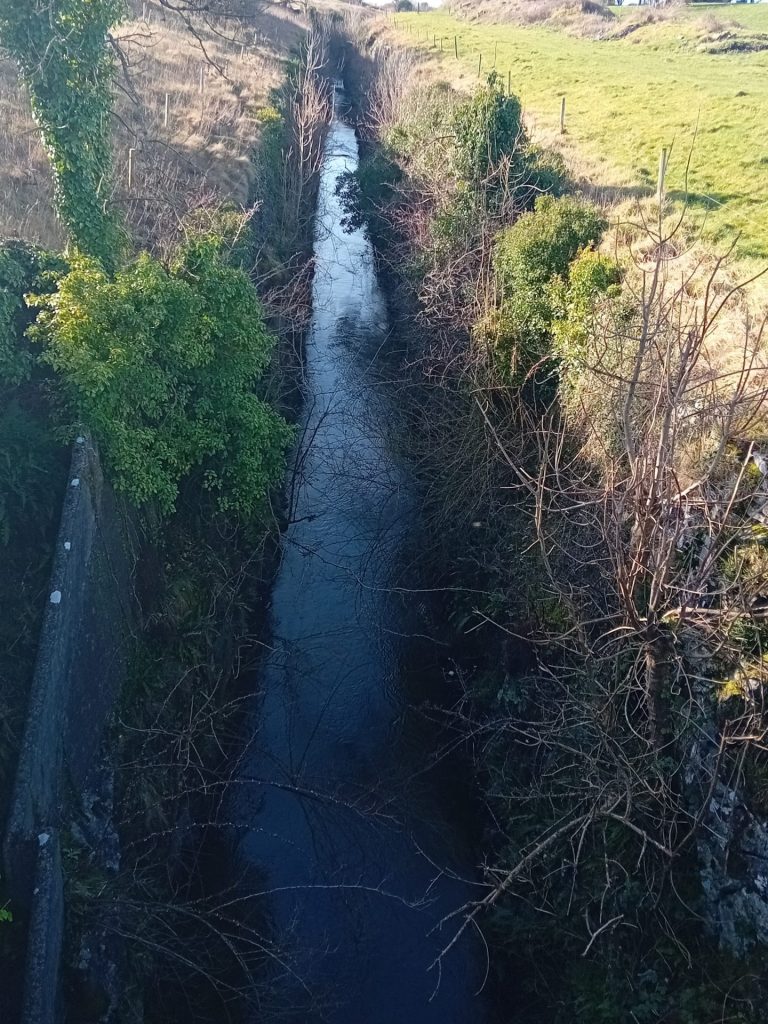
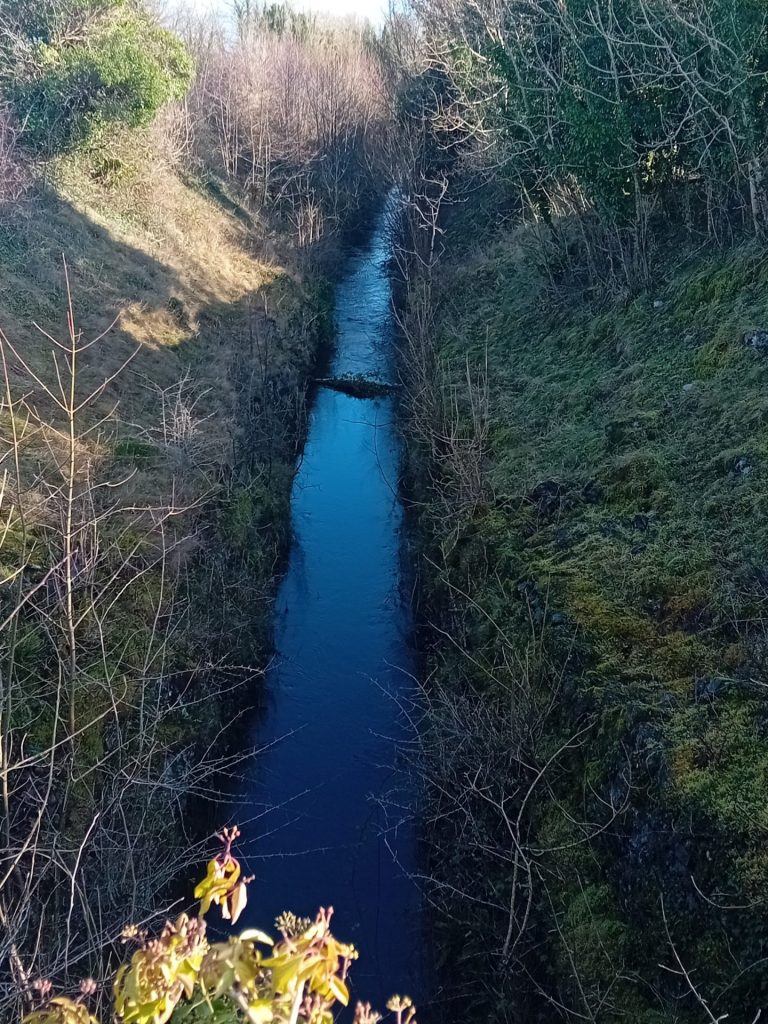
The above images show a limestone stream which was once a brimming, meandering water course, now it is an arrow straight man made gorge where in the high flows of winter the constricted water volume will become a raging torrent.
Nature didn’t evolve rivers and streams to flow this way, flowing water is a changing malleable erosive force. Where there is flow variance, the force of water is constantly moving. Water forced on to a bank will cause erosion and debris which has been eroded, will be deposited in slacker flows down stream. This is how meanders are formed. Material in a flowing watercourse moves. Constriction points will produce scour, again this will move material from the river bed and gravels which are lifted by the increased flow, will be deposited where the current slackens off producing a riffle, pool regime and fresh scoured gravel for wild brown trout and salmon to spawn in.
In the Corrib catchment, our limestone streams would have been moulded by nature in this way. The habitat produced by these natural forces would have been ideal for the production of wild fish and the first pioneers to move in from the sea, would have been brown trout and salmon. With very few competitors they thrived in the conditions which nature had created, unfortunately however, through the interventions of man much of this productive habitat has now been lost.
There are many factors that are effecting wild fish populations, global warming, water quality and invasive species are some of the issues impacting on our wild trout and salmon but the greatest impact of all, has come from from land drainage and it is this impact which Cairde an Chláir is trying to address.
Working in collaboration with the government agency for the protection and conservation of fish in Ireland, Inland Fisheries Ireland, we are committed to restoring nursery habitat which has been lost or damaged to make it productive once again. We prioritise enhancement schemes by assessing the potential of the site, what will give the greatest return for investment of manpower and money and the objective is, to develop a section of headwater stream to produce more wild brown trout and salmon. As an organisation committed to the protection and conservation of wild brown trout and salmon, we always want to do more but the financial constraints and the resources of IFI can only stretch so far. This year, 2025, another 3000 metres of development is planned for Clare river headwater streams but we are pushing our resources to the limit to achieve this. Some of the project work will be stream channels that are 3 metres or more in width and we should remember, that for every square metre of damaged stream habitat that is restored, we are increasing the potential for another wild juvenile fish.
Nature never worked in straight lines and flowing water if left to its own natural devices would not flow in straight lines, however in Ireland, land drainage takes president over nature and we are left with stream channels bereft of natural spawning sites and pool riffle regimes that would support immature fish. Ideally we would like to see banks with slopes of 30% which will help to diffuse the flowing force of water, a force which becomes greater within constricted vertical slopes, and we would like see banks which are pulled in to create constriction points and meanders. This would look more natural and they can be consolidated with structure. Cairde an Chláir will continue to lobby for these improvements and we will continue to work with the positive collaboration we enjoy with IFI. Together we are working toward improving the recruitment of wild trout and salmon in the headwater streams of the Clare river catchment, part of the greater Corrib catchment.
It is difficult within the constraints of a straight channel to produce a development which looks natural. Any new work will leave a scar, however, with time this will heal. It is vital that we introduce gravel and some form of structure but we are restricted on what can be done within the water channel. Every effort is made to meet governing regulations and yet at the same time, we endeavour to improve damaged habitat and create a more naturally flowing watercourse. There are many situations (for more information look at the links provided) where we would prefer to use woody debris to create deflection or constriction points to create scour and flow variance, unfortunately, IFI are not the governing body when it comes to doing work within a stream channel, the Office of Public Works is the official agency which governs this work and they are adverse to wood introduced into a watercourse. In the future we are going to push for more fixed wood introductions and steer away from the more industrial looking stone deflectors, however, irrespective of which material is used it is important to introduce materials which are going to create flow variance and some form of sinuosity within the constraints of an unnatural straight channel. We must never loose sight of our main objective, which is to create habitat that will improve the reproduction and survival of juvenile wild brown trout and salmon and the material introductions are performed to achieve this aim.
The rule of thumb is, if a headwater stream is producing good numbers of wild fish we do not touch it. We only enhance streams which are underperforming and the work which we do, supports a natural sustainable process which is the wild reproduction of brown trout and salmon. This year again we are targeting another substantial tranche of work. The results from this work will not be instantaneously noticed by anglers. Realistically we are looking at five to seven years for the population dynamic to build up, so anglers will need to be patient but if we support the work with good conservation measures, then our populations of wild fish will over time improve and as we began enhancement work in 2020, we have already made a start to achieving this goal.
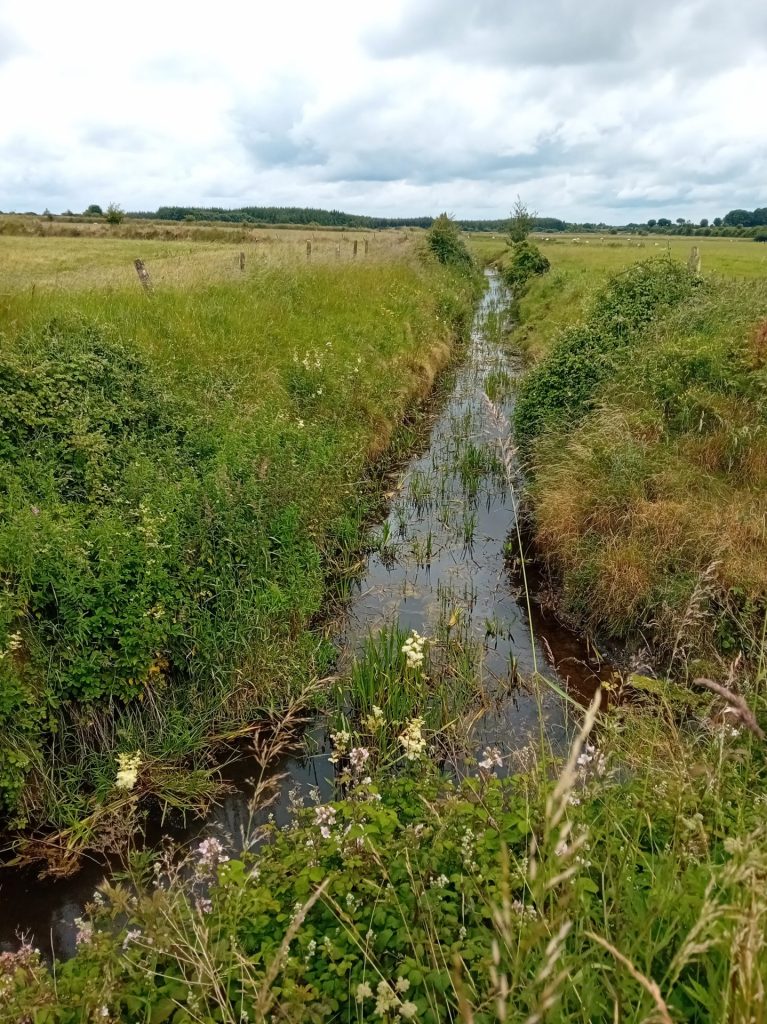
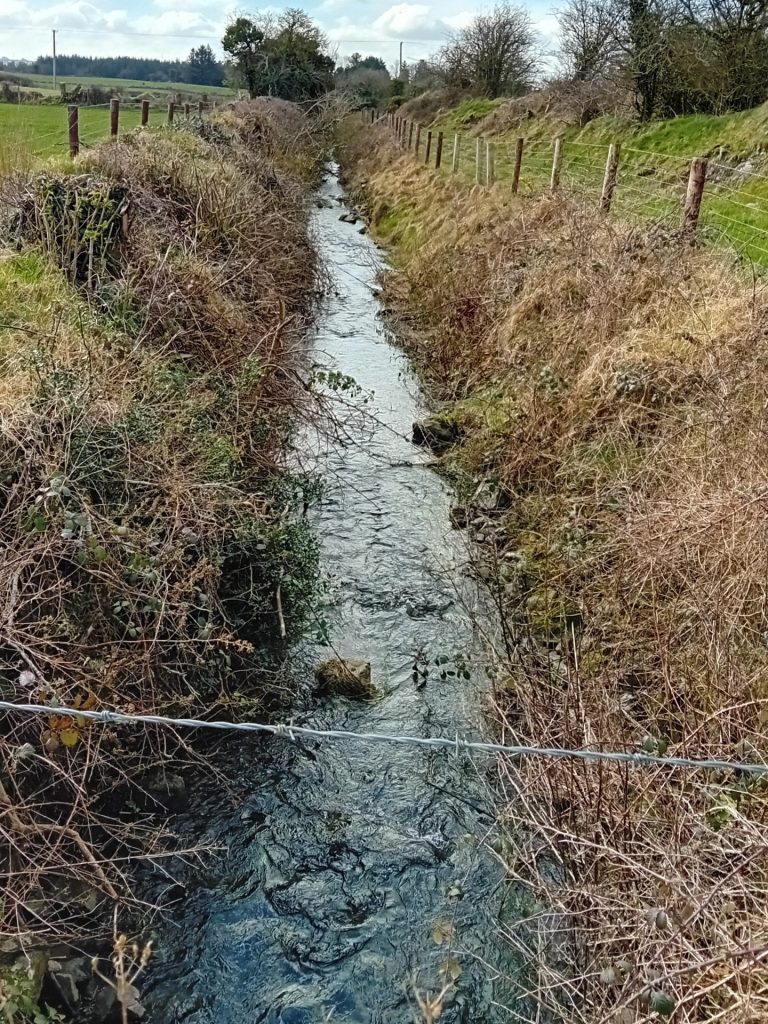

Bereft of feature, a straight channel leading into a slow extended bend and then another straight channel beyond. Banks are grazed down to the waters edge where no protective fencing has been erected. This would have been a very productive limestone stream but with no marginal cover or pool, riffle regime and limited spawning, wild brown trout and salmon have declined.
The above three examples are typical of headwater limestone streams in the Clare river catchment, straight featureless channels with no suitable habitat for producing young brown trout and salmon. These streams would have been brimming watercourses with low banks, blessed with meanders winding their way downstream and a stream channel endowed with pools and riffles. They would have been teeming with young fish, whereas now we are left with what is basically a sterile environment. This has to change and in fairness to OPW, we feel that they now look upon what occurred in Ireland with regard land drainage over the last century was irresponsible and where the environment was concerned, it wasn’t their best period. They are now making an effort to address this situation, hopefully that will continue, and hopefully they will address the issue of their ongoing maintenance programme where they habitually follow up with periodic channel clearing activities. If a channel doesn’t need clearing, then it should not be dredged just because it is on a 5, 10 or whatever year schedule and where instream habitat improvement work has taken place, then this should be exempt from dredging activities. This will give the habitat restoration the time it needs to work and long term they should be left alone, to provide nature with the opportunity to cleanse the scars of damage with her restorative powers.
In Ireland we have a country which has been deforested, consequently carbon absorption has been greatly reduced, methane production has increased, runoff and water flow rate rates have increased accentuating the risk of flooding in high rainfall events, nitrate and phosphate loadings have also gone up. That is some legacy. Humankind has accounted for more species extinctions than any other species which has lived on planet earth and the prime cause for these extinctions, is habitat loss. Here in Ireland when it comes to looking after our environment, we have little to be proud of. The budget from the Department of Agriculture, Food and Marine for farming is over €2 billion and the operational budget for OPW is €700 million and yet for all this financial firepower, we are left with a network of streams and rivers which are nothing more than sterile biodiverse environments with a reduced capacity for producing wild brown trout and salmon. Farmers are now becoming more environmentally aware, they are working with initiatives which have been designed to help improve or maintain water quality and they are implementing strategies to slow down runoff. There is now a willingness for change and a more open minded approach to the way they undertake farming in Ireland and farmers should be compensated for any loss of income if they forfeit any form of profit making practice, that said however, government could and should do more to help our wild fisheries recover.
In the words of Byron, a stanza from Childe Harold’s Pilgrimage
But thou, exulting and abounding river!
Making thy waves a blessing as they flow
Through banks whose beauty would endure for ever
Could man but leave thy bright creation so,
Nor its fair promise from the surface mow
With the sharp scythe of conflict,  --  then to see
Thy valley of sweet waters, were to know
Earth paved like Heaven; and to seem such to me,
Even now what wants thy stream?  --  that it should Lethe be.
References:
Manual River Restoration Techniques – https://www.therrc.co.uk/manual-river-restoration-techniques
Dr Martin O’Grady – https://www.researchgate.net/scientific-contributions/Martin-OGrady-2112051644
Wild Trout Trust – https://www.wildtrout.org/
 English
Leave a Reply